Flashing
From time to time it may be necessary to reprogram the FPGA configuration FLASH memory on the LimeSDR Mini board. This may be required when upgrading to a newer gateware version, or in case of corrupted FLASH memory.
It should usually be possible to program the LimeSDR Mini board using software only, with the device connected via USB interface. However, in case of corrupted FLASH memory or other issues, JTAG programming may be required.
To start with download a pre-compiled programming file (.bin). Then proceed to use the pure software programming method described below, unless it has been determined that JTAG programming is necessary.
Software Programming
This section describes how to program the FPGA configuration FLASH memory on the LimeSDR Mini v2 board using Lime software.
Software
The Lime Suite NG software is required for programming the FPGA configuration FLASH memory.
Programming via the GUI
The programming options can be accessed in the limeGUI application under Modules->Programming.
To program:
Set Programming mode to FPGA/FLASH.
Select the image .bin file you wish to use by pressing Open.
Initiate programming by pressing Program.
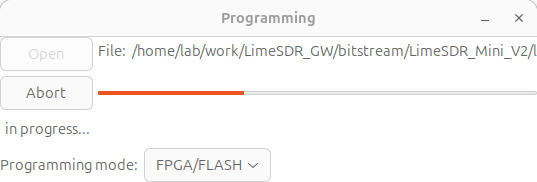
Figure 9: Programming via the GUI
Programming via the CLI
Programming can also be achieved using the CLI application limeFLASH that is built alongside limeGUI.
The relevant options:
device - to choose LimeSDR Mini v2 type
Mini.target - to set programming mode type
FPGA/FLASHand add location to .bin file.
limeFLASH --device Mini --target FPGA/FLASH <path_to>/limesdr_mini_v2.bit
Note
<path_to>/limesdr_mini_v2.bit should be replaced by the actual path to your chosen .bin file